
Reading Kalkaska County Release Records
A Kalkaska County jail release record answers a physical-custody question. It can show when the jail stopped holding a person, which authority permitted the departure, and whether the person went home or to another custodian. A state discharge record answers something else. It marks the end of Michigan Department of Corrections supervision for a sentence. Parole falls between those events because the person has left prison but remains under state supervision.
That distinction matters in Kalkaska County. Someone may leave the county correctional operation on bond, after serving a jail sentence, because of a dismissal, or under another court order. The same person may instead move to Wexford County Jail, MDOC, another county, federal custody, or ICE. A movement between custodians is a transfer. It must not be described as freedom in the community. The Sheriff’s release or transfer form and the court order should be read together when the destination is not clear.
- Release
- The end of one agency’s physical custody. It may be a community release or a transfer.
- Parole
- Community custody under MDOC after release from a state prison.
- Probation
- A court sentence served under supervision, sometimes without a prison term.
- Discharge
- The end of the relevant sentence and MDOC supervision.
- Time served
- A court disposition counting custody already completed toward the sentence.
Kalkaska County Release Types
The legal path controls the next check. The Kalkaska County Sheriff records booking, bonds, property, transfers, and release activity for a jail episode. The court file explains the order or sentence behind that action. State and federal systems become relevant only after those agencies actually take custody.
| Release or movement | What it means | Best next record |
|---|---|---|
| Bond or recognizance | Pretrial custody ends, but the court case continues. | Bond order plus jail release log |
| Time served or sentence completion | The jail term has ended under the court judgment. | Judgment and inmate release form |
| Dismissal or acquittal | The cited case no longer supports detention, though another hold may remain. | Court disposition plus physical-release entry |
| Parole | The person leaves state prison under MDOC supervision. | OTIS Date Paroled and status |
| Probation | The court orders community supervision, which may follow jail or begin without prison. | Probation order and OTIS status |
| Agency transfer | One custodian releases the person to another, not to the community. | Sending record and receiving intake |
| MDOC discharge | State supervision for that sentence has ended. | OTIS DISCHRG status or discharge certificate |
The Kalkaska Sheriff Jail Operations page confirms that corrections staff process people in and out, keep facility records, handle bonds and property, and arrange court transfers. Those functions make the Sheriff the starting records authority for a jail-only event. A jail entry saying “released to MDOC” closes county custody while opening state custody.
Kalkaska County Bond Releases
Kalkaska courts recognize personal-recognizance, cash, ten-percent, and surety bonds. Personal recognizance requires a promise to return rather than a cash pledge. During court hours, bond can be posted with the clerk. After hours, the court directs bond posting to the county jail. The Sheriff adds an important local limit: non-agency bonds posted at the jail must be cash, while questions about other payment routes go to 87-B District Court.
A posted bond supports the legal reason for release. It does not prove the time the person walked out. Another warrant, detainer, or transfer order may still hold the person. Use the Kalkaska bail information to identify the bond route, then request the jail’s release time and destination. Preserve the court’s exact bond terms instead of reducing every bond event to “charges dropped.”
Kalkaska County Release Record Fields
Michigan’s local law-enforcement retention schedule describes the records that may appear in an inmate jacket. It does not promise every listed item exists in each Kalkaska County file, and an exemption may require a redaction. A focused request should name the fields and documents tied to the exact booking.
| Field or document | What it can establish |
|---|---|
| Full name, aliases, date of birth | Identity match for the correct person |
| Booking number and booking date | The specific county custody episode |
| Arresting agency and charges | Why the booking began |
| Court and case number | The matching judicial file |
| Bond type and amount | Terms set for pretrial release |
| Release or transfer date and time | When the holding agency’s custody ended |
| Release authority or disposition | The stated basis for departure |
| Destination | Community release or transfer to another custodian |
| Property release form | Return or transfer of personal property |
| Transfer-to-prison document | Movement into MDOC rather than community release |
The official GS11 schedule also lists booking cards, mug shots, sentencing records, bonds, warrants, and inmate release forms as possible jacket contents. Request the actual record wording. Kalkaska County has no verified public database menu whose labels can safely be assumed.
Requesting Kalkaska County Release Records
The Kalkaska Sheriff requires a written public-record request. Describe existing records rather than asking the office to research an open question. The person’s full name, date of birth, approximate booking date, and known case or booking number help staff locate the right file and avoid a same-name match.
- Confirm whether Kalkaska or Wexford physically housed the person on the relevant date.
- Use the official Kalkaska County FOIA packet and check its current delivery instructions.
- Name the booking card, inmate release form, arrest or detention log entry, bond record, property release form, and any transfer record needed.
- Ask for the actual date, time, destination, and release authority, with exempt matter redacted rather than the whole record withheld.
- Request an electronic copy and an itemized estimate when charges may apply.
605 N. Birch Street
Kalkaska, MI 49646
231-258-8686, extension 1410
records@kalso.org
Monday–Thursday, 7 a.m.–5 p.m.
Friday, 8 a.m.–4 p.m.
The Records Division asks visitors to arrive at least 30 minutes before closing and is closed on most legal holidays. Michigan FOIA generally calls for a response within five business days. That response may grant, deny, partly grant, or invoke one extension of up to ten additional business days. It does not always mean the records will be produced that day.
The Sheriff’s incident-report and photo page lists $5 for the first incident-report page, $1 for each added page, and $1 for a regular-size photo. Those figures do not establish the final cost of an inmate-jacket request. The Sheriff Records screen shows the published contact and office hours.
The captured official page confirms where a written Kalkaska County release-record request can be routed and when in-person service is offered.
Kalkaska County Release Retention Laws
Michigan FOIA, MCL 15.231 and following, governs requests to public bodies. A request must describe the record well enough for the office to locate it. Release plus ten years is the GS11 retention period for an inmate jacket. Other periods differ: arrest and detention log data runs through the end of the calendar year plus five years, while property intake and release records run through year end plus one year.
Retention is not the same as public access. Privacy, an active investigation, juvenile confidentiality, sealed records, security concerns, and other exemptions may permit a redaction or denial. Ask for segregable, nonexempt parts and the statutory reason for any withheld material. Michigan’s FOIA response statute explains the initial response window and possible extension.
Kalkaska County Clean Slate Timing
Michigan’s automatic Clean Slate process links some set-aside timing to release chronology. For an eligible felony, the ten-year clock uses the later of sentence imposition or completion of MDOC imprisonment. Eligibility caps, excluded offenses, and later-conviction conditions still apply. Application-based set-aside timing is separate and generally uses at least five years from the latest of sentence, probation completion, parole discharge, or imprisonment completion.
OTIS removes a conviction after it is set aside by court or operation of law. That means a Kalkaska County release or discharge entry can disappear before OTIS’s usual three-year post-discharge display period for a lawful reason. The Michigan Clean Slate overview gives the state’s automatic rules. Sealed, set-aside, expunged, and juvenile information should not be rebuilt from old fragments.
Booking images may also face separate biometric destruction rules after certain noncharge, dismissal, or acquittal outcomes. Do not assume that every photo remains for the full inmate-jacket period. Note: A removed record may reflect a lawful set-aside or destruction rule, not a failed Kalkaska County release search.
Kalkaska County Release Statistics
The Sheriff’s 2024 annual report recorded 453 inmates, an average daily population of 28.55, and 15 transports to prison. These are system totals, not a name-based release list. Prison transports also represent continued state custody rather than community release.
The source also prints 332 male and 120 female inmates, which sum to 452 rather than the stated 453 total. That one-person inconsistency should stay visible when the report is cited. The official annual-report archive provides aggregate context, but it cannot confirm whether a named person left custody.
Finding Kalkaska County Released Inmates
Kalkaska County does not publish a verified live roster, released-inmate tab, 24-hour list, or 72-hour list. The absence is substantive. A named-person check must use the custodian, court, notification, and records channels that match the event. Start with identity and custody, not a broad web result.
The official Inmate Information page shows bond and VINE directions but no public roster.
The captured county page supports the fallback sequence below. It should not be replaced by another county’s roster or a commercial release page.
- Match the person with full name, date of birth, and any known case, booking, MDOC, or federal number.
- For a recent jail event, call Kalkaska Jail at 231-258-8686 extension 1405 and ask whether the person is still held, was housed in Wexford, or left for a named destination.
- Check the Kalkaska court record for bond, dismissal, sentence, commitment, or another release authority.
- Use OTIS only when state prison, parole, or felony probation is involved. A jail-only release will not appear there.
- Use VINE for participating custody notices, BOP for a federal sentence, and ICE ODLS for possible immigration custody.
- Request the Sheriff release or transfer record when exact time, authority, or destination matters.
| Status or system | What it can show | What to do next |
|---|---|---|
| Still in Kalkaska or Wexford custody | Current physical custodian and custody location | Call the jail because Kalkaska has no public roster |
| Released from county custody | Actual departure, authority, and destination | Request the Sheriff or Wexford release log |
| Transferred into MDOC | County custody ended, but state custody began | Pair the county transfer record with OTIS |
| Released from state prison | Parolee status and Date Paroled, or later discharge | Read the matched OTIS profile and MDOC record |
| Released from federal prison | BOP release date or RELEASED location | Check the federal court record for supervision |
Kalkaska County Release Court Records
Kalkaska’s Circuit, District, and Probate divisions operate within a unified trial-court structure, yet each keeps a distinct case role. District Court usually handles misdemeanors and early felony steps. Circuit Court is normally the durable felony judgment and sentence route. Search the local case interface or MiCOURT, then ask the proper clerk for the register of actions and the actual order.
Look for a bond order, dismissal, acquittal, probation order, judgment of sentence, commitment, or later amended order. These show legal authority. They may not show the minute the jail opened the door. Pair the judicial file with the Kalkaska or Wexford custody record, especially when an order could lead to prison commitment rather than release.
The MiCOURT case-search interface is informational and may not expose the full file. Courts are not handled as Michigan FOIA public bodies for this purpose, so request judicial records from the clerk under court access rules. The District Division can be reached at 231-258-9031, and the Circuit Court Clerk at 231-258-3349. Ask about current copy or certification fees rather than assuming a price.
Search OTIS for Kalkaska Releases
OTIS covers Michigan prisoners, parolees, felony probationers, and people discharged from MDOC supervision within the past three years. It does not cover a Kalkaska jail-only sentence, a city lockup, or a person convicted but not yet sentenced. Search by the six-digit MDOC number when available. Otherwise, use name and identifiers, then open a profile only after the person matches.
| OTIS field | How to use it |
|---|---|
| Last and First Name | Start a name search; confirm identity with other fields. |
| Offender Number | Best direct route when the six-digit MDOC number is known. |
| Age, Sex, Race | Narrow common-name results without treating one trait as conclusive. |
| Marks, Scars, Tattoos | Additional identity details when shown. |
| Offender Status | Choose Parolees, Probationers, Discharged, an absconder category, or All. |
“Date Paroled” is evidence of departure from state prison into parole. “DISCHRG” means the relevant MDOC supervision ended. “Earliest Release Date” is when parole jurisdiction may begin, not a promised departure. “Maximum Discharge Date” is the possible sentence endpoint if parole does not occur first.
The live MDOC OTIS search displays its name, number, and status fields.
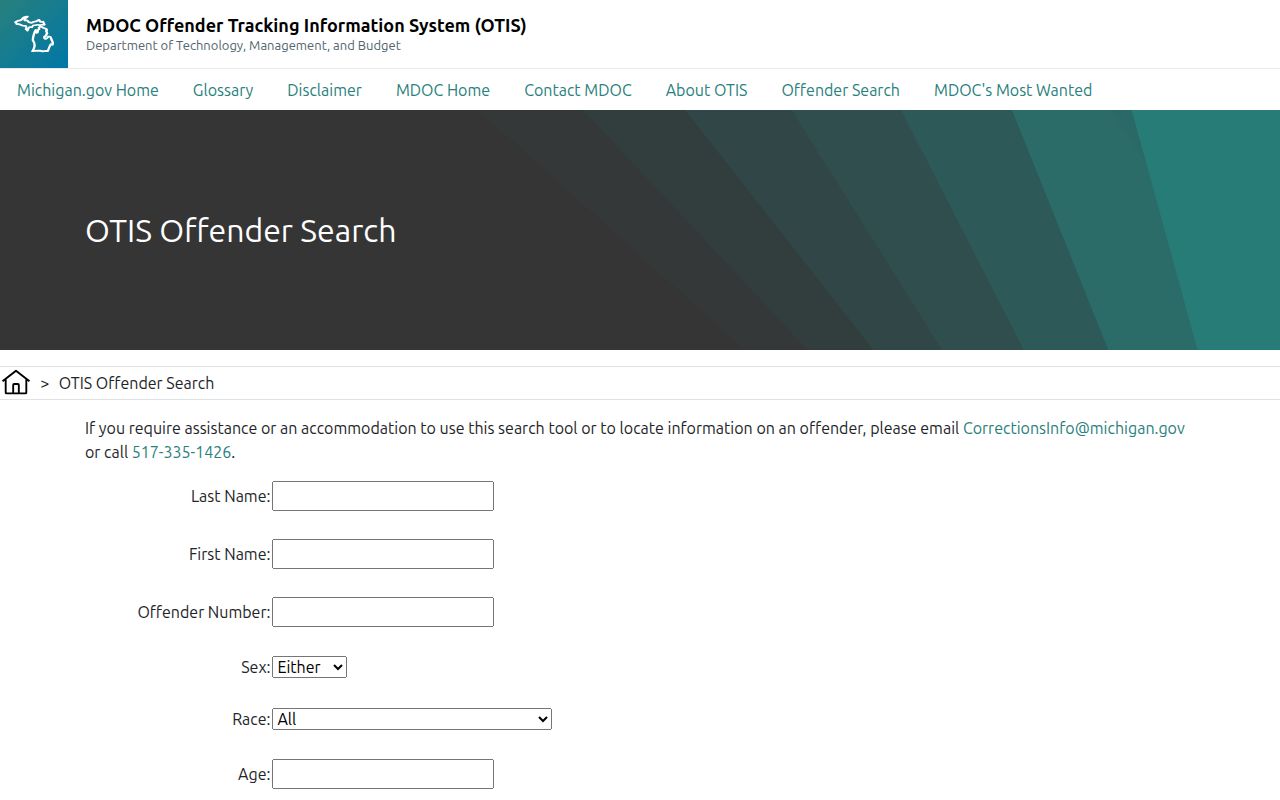
The captured search shows why the correct status filter matters. Discharged, parolee, and probationer results describe different release and supervision stages.
Kalkaska County Release Notifications
MI-VINE offers custody and court information with phone, text, or email alerts. Registration works best while the person is still in custody. Select Michigan, search by name or available ID, and match the person and reporting agency. A later alert should prompt a call to the agency for the exact release type, logged time, and destination.
For phone alerts, the user creates a four-digit PIN and enters it with the pound key to acknowledge the call. Without acknowledgement, the system may retry for up to 24 hours. Kalkaska’s Sheriff specifically directs people to VINE and says staff will make every effort to notify victims of release. Still, VINE is not a permanent archive or certified release record.
The VINELink person search may cover participating county custody. A transfer to MDOC can require use of MDOC’s statutory victim-notification process instead. The Michigan Sex Offender Registry is a separate, limited system for people legally subject to registration, not a broad list of Kalkaska County released inmates.
Kalkaska County Federal Release Checks
A federal case needs federal tools. The BOP locator accepts a BOP, DCDC, FBI, or INS number, or an exact name. A past release date with no facility, or a location marked RELEASED, means the person is no longer in BOP custody. It does not rule out federal supervised release, state or local custody, or immigration custody.
Use the BOP Inmate Locator only for federal prison custody. For ICE custody, ODLS uses full name with an A-number, or name with date of birth and country of origin. ICE says the locator may include people released within the prior 60 days, but it has exclusions and may lag. A negative result is not proof of community release.
An ICE detainer can lead to DHS taking custody after the local jail’s release point. In that event, the Kalkaska County release record marks the end of county custody, not a return home. The U.S. Marshals Service has no public name-based release locator. Federal court records, BOP after commitment, or a properly framed records request supply the next check.
Kalkaska County Community Corrections Releases
Kalkaska Sheriff Community Corrections operates under Michigan Public Act 511 and lists work release, work crew, tether release, rehabilitation programs, and substance testing. These are structured correctional placements. A move into one does not automatically mean the person has reached final discharge.
The 2024 Sheriff report recorded two work-release participants and no tether releases. Those small counts describe program activity only. To verify one person, obtain the governing court order and the program or custody record. A participant may be in the community for approved work while still subject to jail or program control.
The Kalkaska Community Corrections page names the local program functions. Read “work release” or “tether release” as a specific disposition, not as shorthand for completion of every sentence or supervision term.
Getting Home After Kalkaska Release
Kalkaska Public Transit Authority offers countywide demand-response transportation. It is a real local option to investigate after a community release. No official source says a vehicle waits at the jail, that corrections staff reserve rides, or that every pickup time will align with release processing.
Before relying on transit, confirm the current service hours, fare, reservation lead time, and pickup point with Kalkaska’s countywide door-to-door service. Also confirm that the person is actually leaving to the community. A transfer to Wexford, MDOC, ICE, or another jail is not a trip home and requires a different plan.
Can the jail promise a release time? No published Kalkaska source provides routine release-processing hours. Court action, bond processing, other holds, transport, and records work may change timing. Ask the jail for the current status before arranging a ride.
Kalkaska County Release Custody Geography
Kalkaska custody has an unusual local split. County minutes approved use of Wexford through 2024, and the Sheriff’s 2024 report says all inmate visitation occurred in Wexford County. At the same time, the Sheriff site describes a Kalkaska Correctional Division and its local operations. Those historic sources do not prove where every person is held now.
Ask two questions: which county committed the person, and which facility physically held the person on the release date? If Wexford held the person, Wexford may have the departure time and property record. Kalkaska may hold the underlying booking, transport, court, and contract records. A return from Wexford to Kalkaska is a transfer, as is pickup by MDOC or another agency.
This split makes the destination field vital. “Released” in one agency’s log may mean only that its custody ended. Call Kalkaska Jail first at 231-258-8686 extension 1405, then route the documentary request based on the physical custodian identified for that episode.
Kalkaska County Release Facilities
The Kalkaska County Correctional Facility is the primary county jail authority. A community departure is confirmed through the Sheriff’s release record, any VINE notice, and the related court case. A record showing transfer to another custodian needs a second search.
Wexford County Jail has served as an out-of-county custody site for Kalkaska prisoners. When Wexford physically held someone, verify departure with Wexford and the legal basis with Kalkaska Sheriff or the court. A return to Kalkaska, prison transport, or other-agency pickup remains custody.
No state prison, federal correctional institution, or dedicated ICE detention center was found within Kalkaska County. People arrested locally can still enter those systems. OTIS, BOP, or ICE must then be used according to the receiving agency, while the county transfer record proves how the Kalkaska custody episode ended.