
Kalkaska County Parole vs Probation
Parole and probation both involve rules in the community, but they begin in different ways. A parolee has ordinarily left an MDOC prison before the maximum end of an indeterminate sentence and remains supervised by the Michigan Department of Corrections. A felony probationer received probation from a court and may never have entered state prison. In both cases, MDOC Field Operations Administration can supervise the person. The court retains the judicial record for probation, while the Michigan Parole Board is the sole paroling authority for people committed to MDOC.
The status matters when checking a Kalkaska County release. “Parolee” supports departure from prison under supervision. “Probationer” does not prove a prison release. “Discharged” means the relevant MDOC supervision has ended. A person who left the Kalkaska County Correctional Facility after bond or time served may have none of these state statuses.
| Point | Parole | Probation |
|---|---|---|
| How it begins | Release from an MDOC prison under supervision | A court sentence served in the community |
| Key authority | Michigan Parole Board and MDOC | Sentencing court and MDOC Field Operations Administration |
| Best online status | OTIS “Parolees” | OTIS “Probationers” |
| What ends it | Parole discharge or sentence end | Completion or court-authorized discharge |
A few record terms are easy to confuse. Use the agency’s wording rather than treating every end date as the same event.
- Parole
- Supervised community custody after release from an MDOC prison.
- Probation
- A court sentence supervised in the community, often without a prison term.
- Discharge
- The end of the relevant MDOC supervision for a sentence.
- Absconder
- A status showing the person is no longer reporting as required; it is not proof of present location.
Check Kalkaska County Post-Release Supervision
The official starting point is the MDOC Offender Tracking Information System, known as OTIS. It covers Michigan prisoners, parolees, felony probationers, and people discharged within the system’s display window. It does not cover a jail-only sentence or a person held only by the Kalkaska County Sheriff. Search by the six-digit MDOC number when known. A number reduces the risk of choosing a same-name profile.
- Open OTIS and enter the MDOC number, or use the full first and last name.
- Choose Parolees, Probationers, Discharged, or All based on the status being checked.
- Use age, sex, race, or identifying marks only as needed to separate possible matches.
- Open the profile after the identifiers align. Read the exact status, Date Paroled, dates, and listed supervision location.
- If the profile routes supervision to Kalkaska, contact the local MDOC office for status routing or a correction question.
- For formal proof of discharge, use the MDOC records or FOIA channel rather than relying only on the public profile.
The Kalkaska County released-inmate search and record paths explain how to confirm a county-jail departure separately. That distinction is vital. “Released to MDOC” on a jail record means a transfer into state custody, not release to the community.
The image below comes from the official OTIS search and shows the name, number, and status controls used for a supervision check.
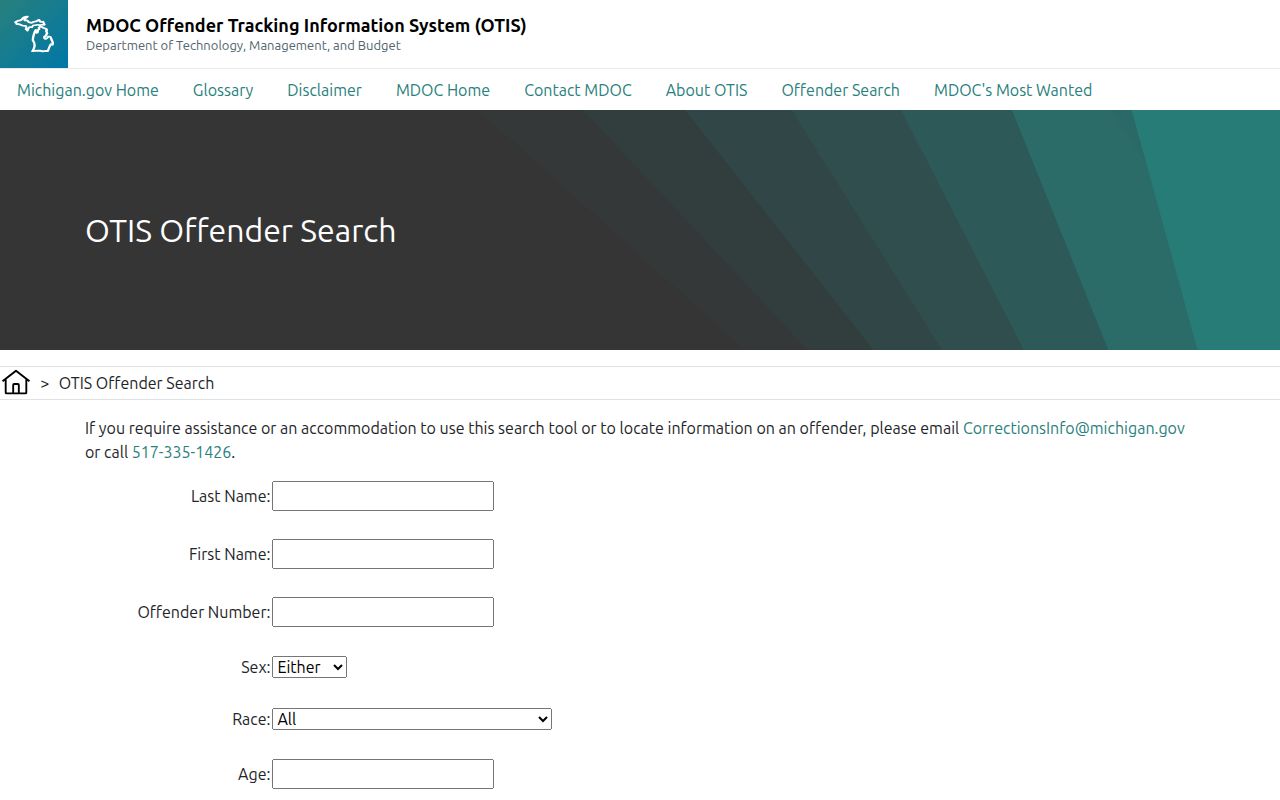
The status filter is a routing tool. A matched profile and the supervising office provide the meaningful verification.
Note: OTIS generally removes people more than three years after MDOC discharge, so an absent older record does not disprove supervision history.
Kalkaska County MDOC Supervision Office
The MDOC Region 2 directory lists a Kalkaska parole and probation office. Use it when OTIS shows Kalkaska or the northern region as the supervision location. Staff can route a question about the current office or an apparent record error, but privacy and operations rules can limit what they disclose. Do not send a jail-release request to this office. Sheriff Records holds the county custody record, and the court clerk holds the order or judgment.
MDOC Kalkaska Parole and Probation Office605 N. Birch Street
Kalkaska, MI 49646
231-258-6911
A displayed address alone does not prove that the Kalkaska office supervises a specific person. OTIS may list another field office based on where the person lives or where the case is assigned. Start with the profile. Then call the office shown there.
Kalkaska Supervision and Absconder Status
Supervision conditions come from the sentence, Parole Board order, and MDOC rules. They can include reporting, approved residence, treatment, substance testing, travel limits, and compliance with the law. The exact terms are person-specific. Public OTIS data should not be used to guess the full condition set or to assume that a missed appointment caused a violation.
No official Kalkaska County absconder or warrant list was found. OTIS does provide Parole Absconders and Probation Absconders as search categories. An absconder label means the person is recorded as not reporting as required. It is not a new conviction, an address, or proof of present location. Verify the live entry through the listed field office. A separate court or law-enforcement record is needed to establish a warrant.
MI-VINE can send custody or court-event alerts when a person is in a participating system. It is not a parole-condition ledger. For a person already under MDOC supervision, OTIS and the supervising office are the direct channels.
Note: A parole or probation violation can lead to custody, but a status label alone does not show the final violation outcome.
Kalkaska County Community Corrections
The Kalkaska County Sheriff’s Community Corrections program is grounded in Michigan Public Act 511. The local program lists work release, work crew, electronic tether release, rehabilitation programming, and substance testing. These paths can place a person outside a cell for approved work or programming while correctional controls continue.
The Sheriff’s 2024 annual report recorded two work-release participants and no tether releases. Those figures describe program use, not individual parole or probation status. Work release and tether are structured corrections dispositions. They must not be labeled final discharge without the court, jail, or MDOC record that says supervision ended.
That local layer is why “out of jail” is not enough. A person may be on a county program, felony probation, state parole, or no supervision at all. Identify the legal authority first, then use the matching record system.
When Kalkaska County Supervision Ends
A parolee is not fully discharged merely because the person left prison. OTIS may show Date Paroled as the past prison-departure event while the current status remains Parolee. “DISCHRG” is the state-system term showing that the relevant MDOC supervision ended. For probation, the court record may also be needed to show completion or an order ending the term.
The Michigan Parole Board begins its consideration process about six months before eligibility or reconsideration. It examines the sentence, prison history, conduct, programs, risk information, interview, and other material. Eligibility does not guarantee parole. MDOC also says at least 28 days normally pass between a Board release decision and physical release.
Michigan also posts certain public-hearing notices, with registration due two business days before a listed hearing. An individual dated notice proves only that possible parole will be considered. It is not a comprehensive decision calendar or proof of release.
Use Date Paroled and current OTIS status to confirm implementation. If a formal end-of-supervision record is needed, request the discharge certificate through the MDOC FOIA process. MCL 791.234 governs core parole jurisdiction. Exempt material may be withheld or redacted.
The public profile has limits. OTIS may contain inaccurate, incomplete, or outdated information, and discharged profiles generally age out after three years. A sentencing-record correction goes to the court, while a supervision-location error goes to the listed field office. MDOC updates its entry from proper official information. If a profile has disappeared, the court file and an MDOC records request are better evidence than an inference based on the search result.
A final check should name the event being proved: departure from prison, current parole, current probation, or discharge. One date cannot stand for all four.