
Kalkaska Projected vs Actual Release
“Projected release date” is a useful search phrase, but Michigan’s records use more exact terms. For an MDOC prisoner, OTIS may show an Earliest Release Date and a Maximum Discharge Date. The earliest date generally marks when the Parole Board may acquire jurisdiction. It is not an appointment to leave. Maximum discharge is the possible sentence endpoint if parole does not occur first. A populated Date Paroled records the later event of leaving prison on parole.
A Kalkaska County jail case follows another path. A sentenced jail prisoner may have a calculated end date subject to time served and county-jail good time. A pretrial detainee has no fixed sentence-release date. Release may instead turn on bond, dismissal, a court order, another hold, or later sentencing.
Ask what date is actually needed. Parole eligibility, a jail sentence end, physical departure, and final discharge from supervision are four different events.
Find a Kalkaska Projected Release Date
Start with the custodian. OTIS covers state prisoners, parolees, felony probationers, and recent discharges. It excludes county-jail inmates and jail-only sentences. Kalkaska Sheriff Records and the court are the right channels for a county sentence. If official records show the person was housed in Wexford County Jail, also determine which agency calculated and logged the departure.
- Identify whether the person is pretrial, serving a county-jail sentence, or committed to MDOC.
- For MDOC custody, open OTIS and search by the six-digit MDOC number or full name.
- Match identity details before reading the profile. Note the exact status, Earliest Release Date, Maximum Discharge Date, and Date Paroled when present.
- For a county sentence, obtain the judgment or commitment from the court and ask the Kalkaska jail for its official time and good-time calculation.
- For a pretrial case, review bond and court orders, then ask the physical jail about holds or a completed departure.
- Confirm an actual event with the releasing custodian rather than treating an estimate as final.
The Kalkaska County release search gives the broader custodian-by-custodian path when it is not yet clear which agency held the person. A movement from the county jail to MDOC is a transfer into state custody, not release from a state sentence.
Note: Use an MDOC number when available because a precise identifier greatly reduces the risk of relying on a same-name profile.
Kalkaska OTIS Sentence Date Fields
OTIS uses an indeterminate sentence framework with minimum and maximum dates. The MDOC glossary defines the date and status terms. The minimum side controls when parole jurisdiction can begin under applicable law. The maximum side marks the possible end if release on parole does not happen earlier.
A result should be transcribed with its original label. Calling an Earliest Release Date a “scheduled release” overstates the record. Calling Maximum Discharge an expected pickup date does the same. Date Paroled, if present, is stronger proof of past physical departure from prison, although parole supervision continues afterward.
| OTIS field | Meaning |
|---|---|
| Earliest Release Date | The point when parole jurisdiction may begin, not guaranteed departure |
| Maximum Discharge Date | The potential sentence endpoint if parole does not occur first |
| Date Paroled | A past event showing departure from prison on parole |
| Current status | Whether the person is a prisoner, parolee, probationer, discharged, or another listed category |
The image below comes from the official MDOC OTIS overview and documents its scope, exclusions, display window, and accuracy limits.
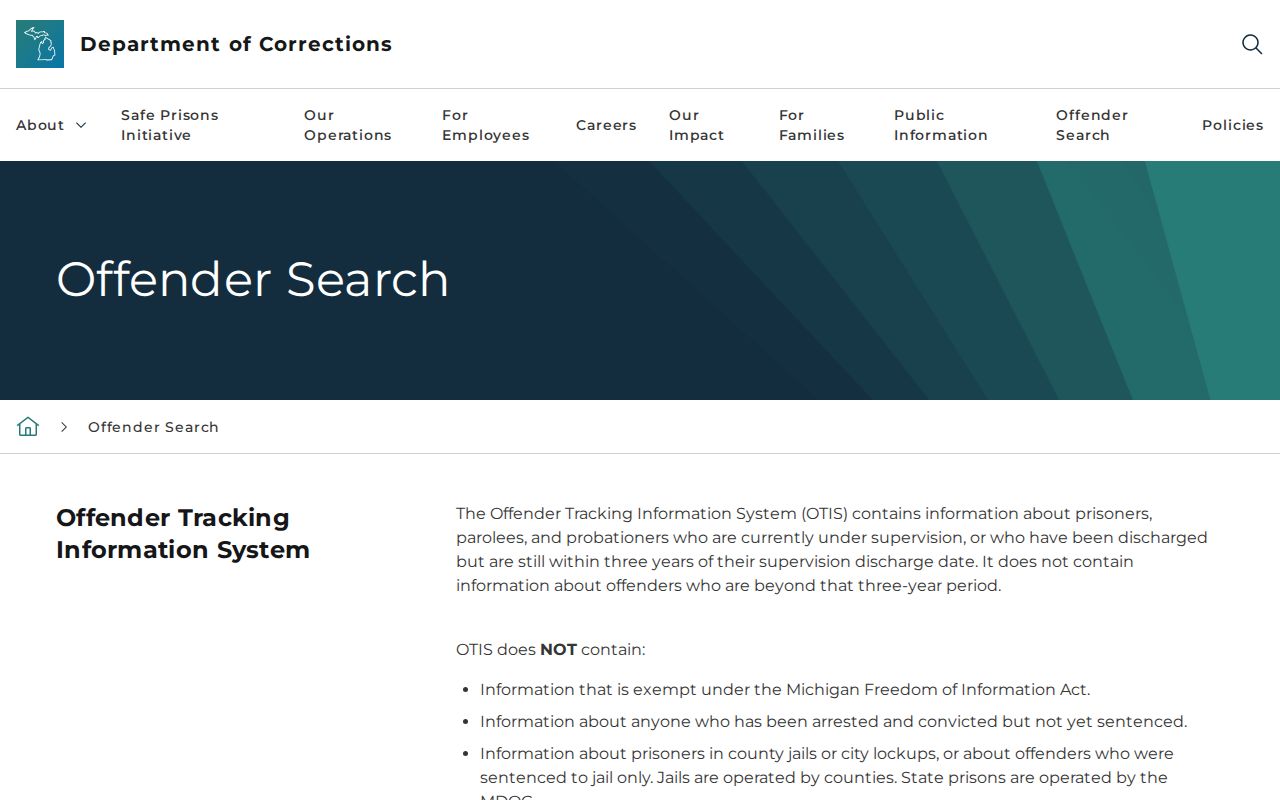
Those limits explain why OTIS is authoritative for MDOC status but cannot supply a Kalkaska jail-only release date.
Michigan Truth in Sentencing Dates
Michigan truth in sentencing is not a rule that everyone serves about 85 percent. For covered sentences, it requires service of the entire judicial minimum in prison before parole eligibility. The rule applies to specified assaultive crimes committed on or after December 15, 1998, and other covered crimes committed on or after December 15, 2000. Good-time or disciplinary credits do not reduce that minimum.
The MDOC truth-in-sentencing explanation is the primary source for the full-minimum rule. Older sentences may receive different treatment based on the offense and date. The disciplinary-time statutes, the Michigan Corrections Code, and MCL 791.234 are governing authorities.
Even when the minimum has been served, the Parole Board must make a release decision. MCL 791.233 requires reasonable assurance that the person will not become a menace to society or public safety. A date calculation alone cannot compel parole.
Note: The offense date and sentence law matter, so a rule from one Michigan sentence should not be copied onto another.
Kalkaska County Jail Good Time
County-jail good time is separate from MDOC truth in sentencing. MCL 51.282 provides a county-jail prisoner with no rule violations a reduction of one day for each six days of sentence. The sheriff may prescribe forfeiture for infractions, take earned time for insubordination, and restore some or all lost time after a minor infraction as a reward for especially good conduct.
MCL 51.283 addresses posted jail rules and good-behavior allowances. It also addresses the prisoner’s duty to call the allowance to the sheriff or deputy’s attention. These laws provide the framework, but they do not produce a safe public calculator for a particular Kalkaska County sentence.
An exact date depends on the commitment, credited time served, the jail’s calculation, violations, forfeitures, and any restored time. Ask the jail for the official computation. If the person was physically housed at Wexford, determine whether Kalkaska or Wexford holds the calculation and final departure entry.
Kalkaska Pretrial Dates and Holds
A pretrial detainee does not have a sentence end to calculate. The next possible release may depend on a personal-recognizance bond, cash bond, ten-percent bond, surety bond, dismissal, acquittal, or a later court order. Kalkaska court records can show the legal action. The jail record shows whether and when staff implemented it.
Bond posting does not always produce immediate physical departure. Another warrant, detainer, or agency pickup can keep the person in custody after the bond condition is met. A court entry that cash bond was posted supports the legal mechanism, but it does not prove there was no hold. Ask the jail whether the person was released to the community, returned to Kalkaska from Wexford, transferred to MDOC, or picked up by another custodian.
The local court says bond can be posted with the clerk during business hours and at the jail after hours. The Sheriff says non-agency bonds posted at the jail must be cash and directs other payment questions to 87-B District Court. Those procedures explain how a release can begin, but neither office publishes a fixed processing time. Do not create a pickup estimate from the bond timestamp alone.
For exact proof, pair the bond or court order with the jail disposition. Request the actual departure date and time, release authority, and destination. If the entry shows a transfer, follow the receiving agency’s system instead of treating the local custody end as freedom.
Note: Kalkaska publishes no official release-processing schedule, so court and jail records must establish timing for each person.
Why Kalkaska Release Dates Change
A date can move because the legal sentence, earned credit, custody path, or Parole Board action changes. The effect depends on whether the person is in county jail or state prison. A hold can also prevent community release even after one sentence or local custody basis ends.
| Factor | Possible effect | Best confirming source |
|---|---|---|
| Misconduct or jail infraction | Loss of applicable credit or good time | Custodian’s disciplinary and time calculation |
| Restored county good time | Earlier calculated county-sentence end | Kalkaska jail calculation |
| Sentence correction or consecutive term | Changes minimum, maximum, or sequence | Sentencing court and MDOC record |
| Parole Board action | Release after eligibility, denial, or later reconsideration | Board decision and OTIS status |
| Detainer or another warrant | Transfer to another agency rather than community release | Sending log and receiving custodian |
| Court order | Changes custody authority or sentence terms | Signed order and jail implementation record |
MDOC says at least 28 days normally separate a Board release decision from physical release. Thus, “parole granted” is not yet the same as Date Paroled. The latter and current OTIS status show that the state release was implemented.
Confirm a Kalkaska Release Date
For a pending county event, MI-VINE can send a custody alert while the person is in a participating system. The Kalkaska County VINELink check explains registration, the telephone PIN, and why a transfer notice needs follow-up. An alert is a prompt to verify. It is not a certified release form.
For a jail sentence, ask the Sheriff for the actual release or transfer date, time, authority, and destination. Check the court file for the judgment or order that supplied legal authority. If Wexford physically held the person, verify which jail made the departure entry. A transfer to MDOC, ICE, or another jail is not a community release.
For a state prisoner, preserve the OTIS fields and current status. If Date Paroled appears, it records prison departure onto parole. If the status is DISCHRG, the relevant MDOC supervision has ended. For formal proof, request the release order or discharge certificate through the MDOC FOIA process.
A reliable answer names the event and its source. “Eligible,” “parole granted,” “left county custody,” “Date Paroled,” and “discharged” should never be collapsed into one projected date.
Note: Tie every Kalkaska release date to its source, status label, and current custodian before relying on it for pickup plans.